
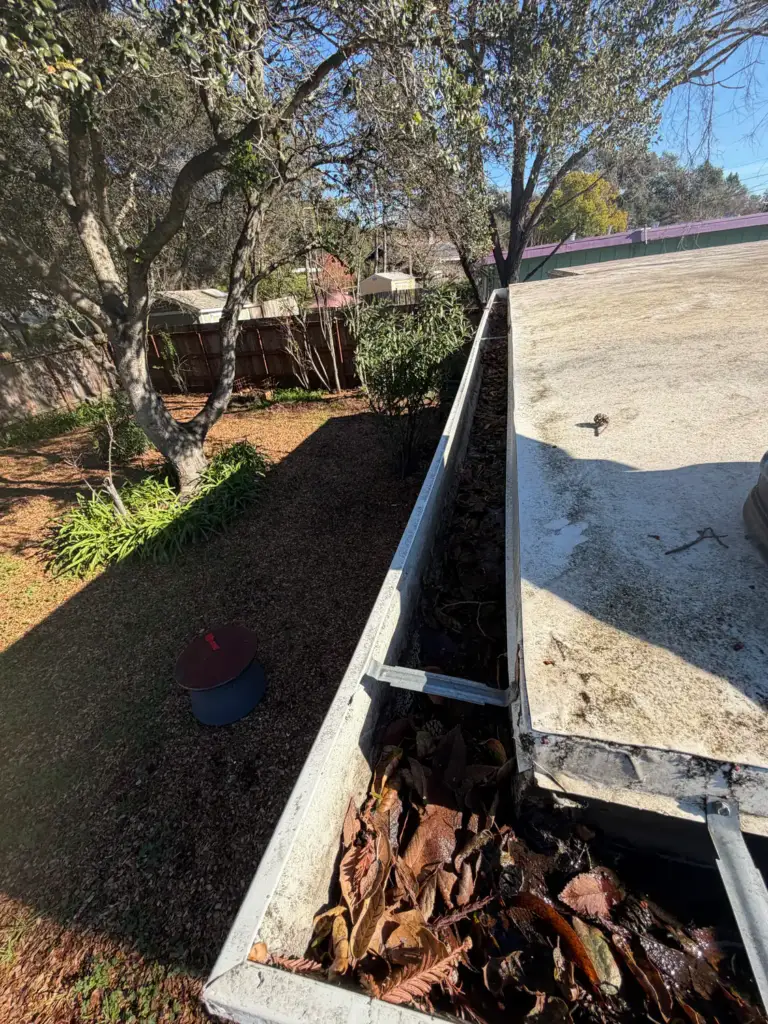
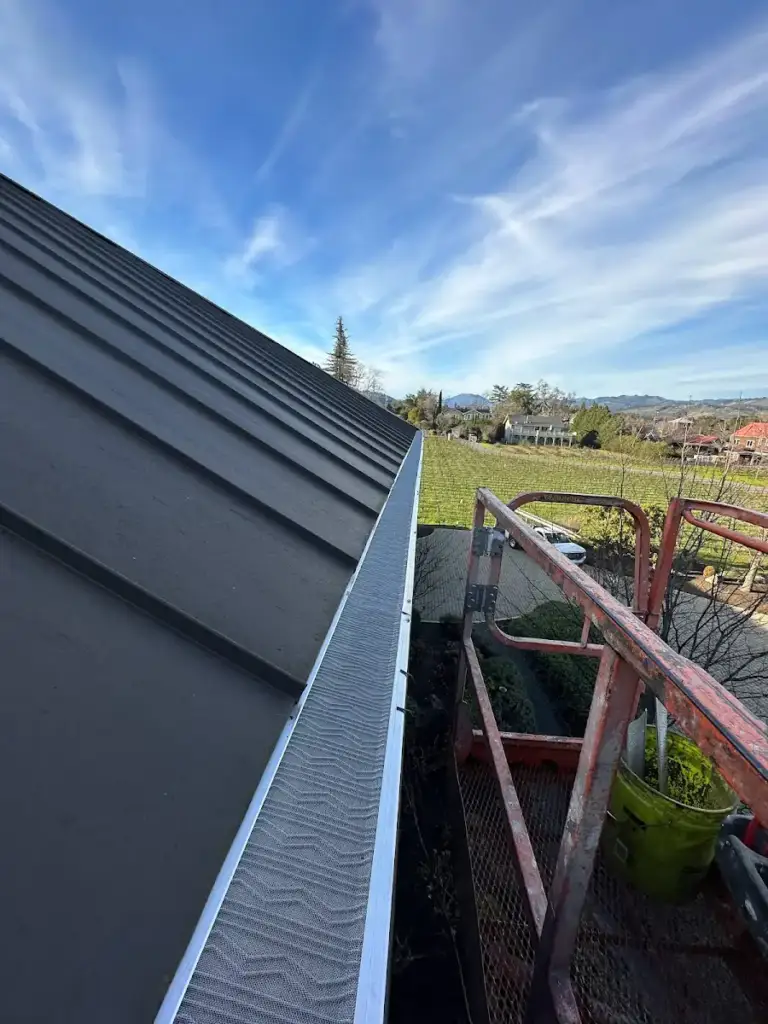
An ember-resistant gutter guard is a noncombustible cover, usually metal, that keeps leaves and needles from collecting where wind-blown embers can land. It helps by taking fuel away from the roof edge. It doesn’t make a house fire-safe, and it still needs upkeep. Here’s what CAL FIRE, state law and the 2025 California Wildland-Urban Interface Code say about gutters, and where a cover fits in your fire-season prep.
Why do dry leaves in gutters matter during fire season?
Because they’re fuel sitting right at the roof edge. UC ANR’s fire network calls debris buildup in gutters “one of the greatest fire hazards for a building,” and explains that if embers ignite leaves or needles there, the fire exposes the edge of the roof directly to flames. By late summer that debris is bone dry.
Embers don’t need a fire front close by. CAL FIRE’s Hardening Your Home page warns that flying embers can be “capable of igniting homes up to a mile away.” That’s why the page treats rain gutters alongside roofs and vents, and why a clean gutter in September matters even when the nearest fire seems far off.
What is CAL FIRE's advice for gutters?
Three things, all on its Hardening Your Home page. Keep gutters clear of plant debris to prevent ember ignition. Add a noncombustible metal drip edge to protect the roof’s edge. And for gutter guards, CAL FIRE says to “use noncombustible gutter covers” so debris stays out and upkeep goes down.
Noncombustible is the word that matters. Plastic, foam and bristle inserts can burn. UC ANR’s fire network notes that non-metallic covers may burn in a fire, though they aren’t necessarily a risk as long as the gutters stay clean. A metal cover takes that question off the table. Our gutter guard installation page shows the cover types we fit, from micro-mesh to expanded metal.
What is Zone 0, and where do gutters fit in it?
Zone 0 is the ember-resistant zone, the first 5 feet around a house, deck or other structure. CAL FIRE’s defensible space page says it focuses on intense fuel reduction against ember attack, and its Zone 0 list includes checking roofs and gutters. The same page notes that Zone 0 is not legally required yet.
State law already points that way. Public Resources Code 4291 calls for an ember-resistant zone within 5 feet of a structure, based on regulations from the state’s Board of Forestry and Fire Protection. Until those rules apply, CAL FIRE’s defensible space page is the place to check the current guidance before planning yard work around it.
What does Public Resources Code 4291 say about roofs and gutters?
It requires anyone who owns or maintains a building in the state responsibility area to “maintain the roof of a structure free of leaves, needles, or other vegetative materials.” The law names the roof rather than the gutter, but debris on a roof edge ends up in the gutter, so the two get cleared together.
Read the full text of Public Resources Code 4291 on the state’s legislative site. The State Fire Marshal’s fire hazard severity zone maps cover both state and local responsibility areas, and your local fire agency can tell you which rules apply at your address.
A cover doesn’t change what the law asks. Leaves on the shingles still have to come off, and a cover with leaves piled on top is still holding fuel at the roof edge. That’s why covers and roof and gutter cleaning go together.
What does the 2025 WUI Code require for gutters?
Under Section 504.4 of the 2025 California Wildland-Urban Interface Code, gutters and downspouts “shall be constructed of noncombustible material,” and gutters need “an approved means to prevent the accumulation of leaves and debris in the gutter.” Ask your building department whether a project of yours falls under it.
Section 503.1 of the same code applies these construction rules to buildings “hereafter constructed, modified or relocated into or within wildland-urban interface areas.” In plain terms, it governs construction: new buildings, plus existing ones being modified or moved in those areas. If an addition or a rebuild is on your calendar, read Chapter 5 of the WUI Code and check with the building department before work starts.
What can an ember-resistant gutter cover do, and what can't it do?
It can keep leaves and needles out of the trough, so there’s less dry fuel along the roof edge for embers to find. It can’t stop embers from landing, it can’t keep debris off the shingles, and it doesn’t replace cleaning. Debris that piles up on top of any cover can still ignite.
UC ANR’s fire network shows an example: a screen kept debris out of the gutter, but debris collected on the roof covering instead. Its conclusion: “The roof still needs to be cleaned on a regular basis.” A cover is one piece of the job, alongside a clear roof, a metal drip edge, screened vents and a cleared 5-foot zone.
One customer, Misti W., put the relief this way in her review: “I’m relieved to finally have high-quality gutter covers that will protect my home from embers during wildfires.” Our own claim is plainer: a cover that’s kept clear means less fuel at the roof edge. No cover can promise a house comes through a fire.
Questions we hear about this
Will gutter guards lower my home insurance?
Nobody can promise that. The California Department of Insurance’s Safer from Wildfires page lists ten home and community steps it says can help with insurance, such as a Class A roof, a 5-foot ember-resistant zone and ember-resistant vents. Gutter covers aren’t named on that list, so ask your own insurer what they count before assuming any change.
How often should gutters be checked in fire season?
Look before summer dries everything out, and again late in the season after windy days bring down needles and leaves. Under redwoods and pines, gutters and roofs can fill faster than you’d expect. Our rainy-season exterior checklist picks up the fall side of the same routine.
What does CAL FIRE say about ember-resistant vents?
Vents are another opening CAL FIRE calls out. Its hardening page recommends 1/16-inch to 1/8-inch noncombustible, corrosion-resistant metal mesh over vents, or vents approved by the State Fire Marshal, and says to check with your local building official about ventilation requirements first, since these changes may reduce airflow to attics and underfloor spaces.
Sources
- CAL FIRE Ready for Wildfire: Hardening Your Home
- CAL FIRE Ready for Wildfire: Defensible Space and Zone 0
- California Public Resources Code 4291
- 2025 California Wildland-Urban Interface Code, Chapter 5 (Sections 503.1 and 504.4)
- UC ANR Fire Network: Gutters
- Office of the State Fire Marshal: Fire Hazard Severity Zones
- California Department of Insurance: Safer from Wildfires