
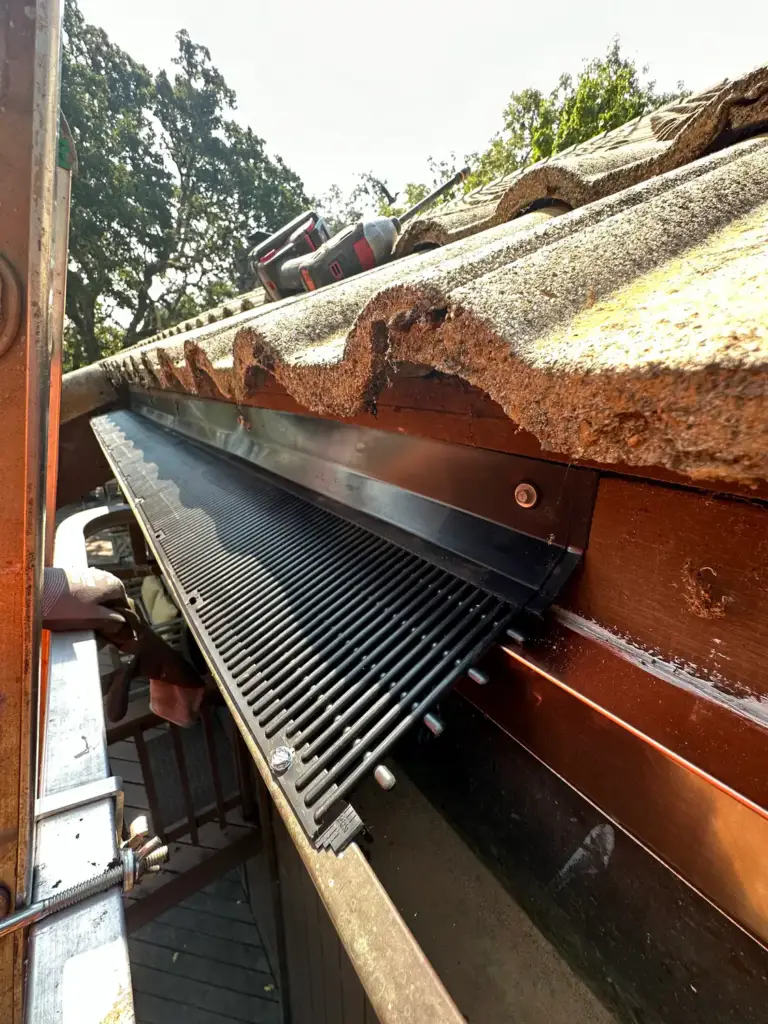
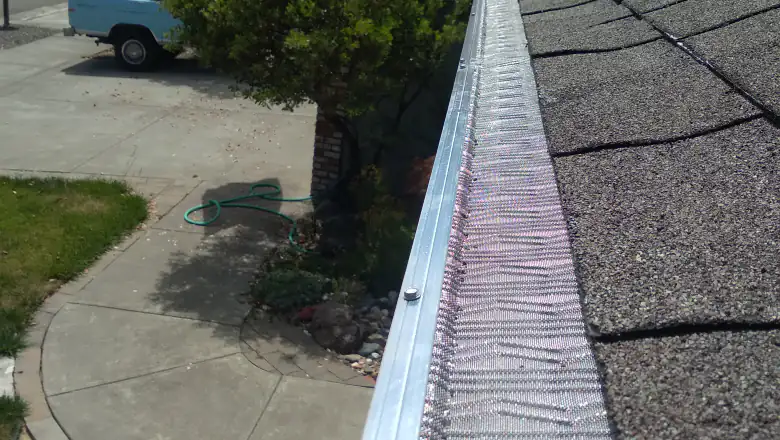
Most gutter guards fall into one of seven types: mesh, micro-mesh, screens, expanded metal, surface-tension (reverse-curve) hoods, foam inserts and brush inserts. Each one keeps some debris out and lets some in. Which one suits a house depends mostly on what your trees drop and how your roof is built. This guide compares them plainly, with no rankings, so you can see how each behaves under the redwoods, oaks and pines common around Sonoma County.
How do mesh and micro-mesh gutter guards work?
Both lay a metal mesh across the top of the gutter, so water passes through and debris stays out. Standard mesh has openings small enough to stop leaves and many needles. Micro-mesh goes finer, stopping needles, seed pods and roof grit, and it’s usually stretched over a stiff frame so it doesn’t sag between fasteners.
Handles well: redwood and pine needles, which is where a finer mesh earns its place.
Struggles with: very fine material. Pollen, oak tassels and dust can coat the surface over a dry season and slow the water getting through, so micro-mesh needs an occasional brushing or rinse. On clay tile the mesh has to be fitted under the tile curve, which takes more care than a flat shingle edge.
What about screens and expanded metal guards?
Screens and expanded metal both have bigger openings than mesh. A screen is a grid of wire or plastic that snaps into the gutter. Expanded metal is a sheet cut and stretched into diamond-shaped holes, which makes it stiffer. Both do a good job keeping out broad leaves. Needles are their weak spot.
Handles well: oak, bay and other broad leaves, which can’t fit through the openings and tend to dry out and blow off.
Struggles with: redwood and pine needles, which poke into the openings and build a mat that holds water. Plastic screens can also warp in the sun over the years. In wildfire country, CAL FIRE’s guidance is to choose noncombustible covers, which leaves plastic out.
How do surface-tension or reverse-curve gutter guards work?
A solid hood covers the gutter and curls over its front edge. Rain follows that curve around and drops through a narrow slot into the trough, while leaves ride off the edge to the ground. They shed broad leaves well, but fast, heavy rain can overshoot the curve, and needles can lodge in the slot.
These hoods usually slide under the first row of shingles, so the roof type matters, and they’re easy to see from the street. Because debris drops off the front, expect leaves in the planting beds below. UC ANR’s fire network notes that a combination cover, solid near the roof and screen near the lip, “could cause the accumulation of debris in the gutter-roof interface.” That seam is worth checking on any hood-style guard.
Are foam and brush gutter inserts worth it?
They’re the simplest to put in, which is their main appeal. Foam is a porous block laid in the trough, and brush inserts are long bristle cylinders. Both catch large leaves, but needles and small debris settle into them, and they have to come out to be cleaned. Most are made of combustible materials, too.
Handles well: a light fall of broad leaves on a low gutter that’s easy to reach.
Struggles with: redwood and pine needles, which weave into bristles and lie in the top of the foam. Foam that stays damp can hold seeds and grit, and in fire season dry debris resting on any combustible insert is fuel at the roof edge. UC ANR’s fire network advises, “If possible, avoid combustible materials that could burn during a fire.”
Which type of gutter guard suits Sonoma County trees?
It depends on which trees are over your roof. Under redwoods and pines, finer mesh is usually the starting point, because needles get through anything coarser. Under oaks and bay, screens, expanded metal and standard mesh can all keep leaves out. Eucalyptus drops long leaves and bark strips, so look for something firm that sheds well.
- Redwood and pine: micro-mesh or a fine mesh.
- Oak and bay: mesh, screens or expanded metal; micro-mesh also keeps them out but may need more brushing when the oaks drop their tassels.
- Eucalyptus: a firm, well-supported cover that bark strips can slide off.
- Mixed trees: choose for the finest debris you get.
Dave walks through this debris-first approach in his Diamond Certified tip on choosing gutter covers.
How are the different types attached to a roof?
Three ways, mostly. Some guards fasten to the front lip of the gutter and rest on its back edge. Some slide under the first course of shingles. Others drop inside the trough with no fasteners at all, like foam and brush. The method matters because it decides how the guard meets your roof edge.
On clay or concrete tile, a guard usually can’t slip under the tiles, so it has to be shaped to sit beneath the curve. Metal roofs need a guard that meets the panel edge without bending it. On shingle roofs, ask whether the method lifts shingles, since that can matter to whoever installed the roof. Our gutter guard service covers shingle, tile and metal roofs.
Questions we hear about this
Can I install gutter guards myself?
Some types, like foam and brush inserts, are sold for homeowners to drop in. The harder parts are the ladder work, cleaning and repairing the gutter first, and fitting a cover to your roof edge and your trees. A cover laid over a leaking or sagging gutter only hides the problem. If you’d rather stay off the ladder, get in touch.
Do any gutter guards stop all debris?
No. Every type lets something through or holds something on top. Fine mesh keeps out needles but can collect pollen and dust, and hoods shed leaves but can let needles into the slot. UC ANR’s fire network says gutter covers “may still require periodic attention,” so plan on an occasional check whatever you choose.
Should gutter guards be metal in wildfire season?
CAL FIRE’s home-hardening guidance says to use noncombustible gutter covers, and in practice that means metal rather than plastic, foam or bristle. Even a metal cover has to be kept clear, though, because leaves resting on top can still catch embers. Our post on ember-resistant gutter guards goes into the fire rules.